
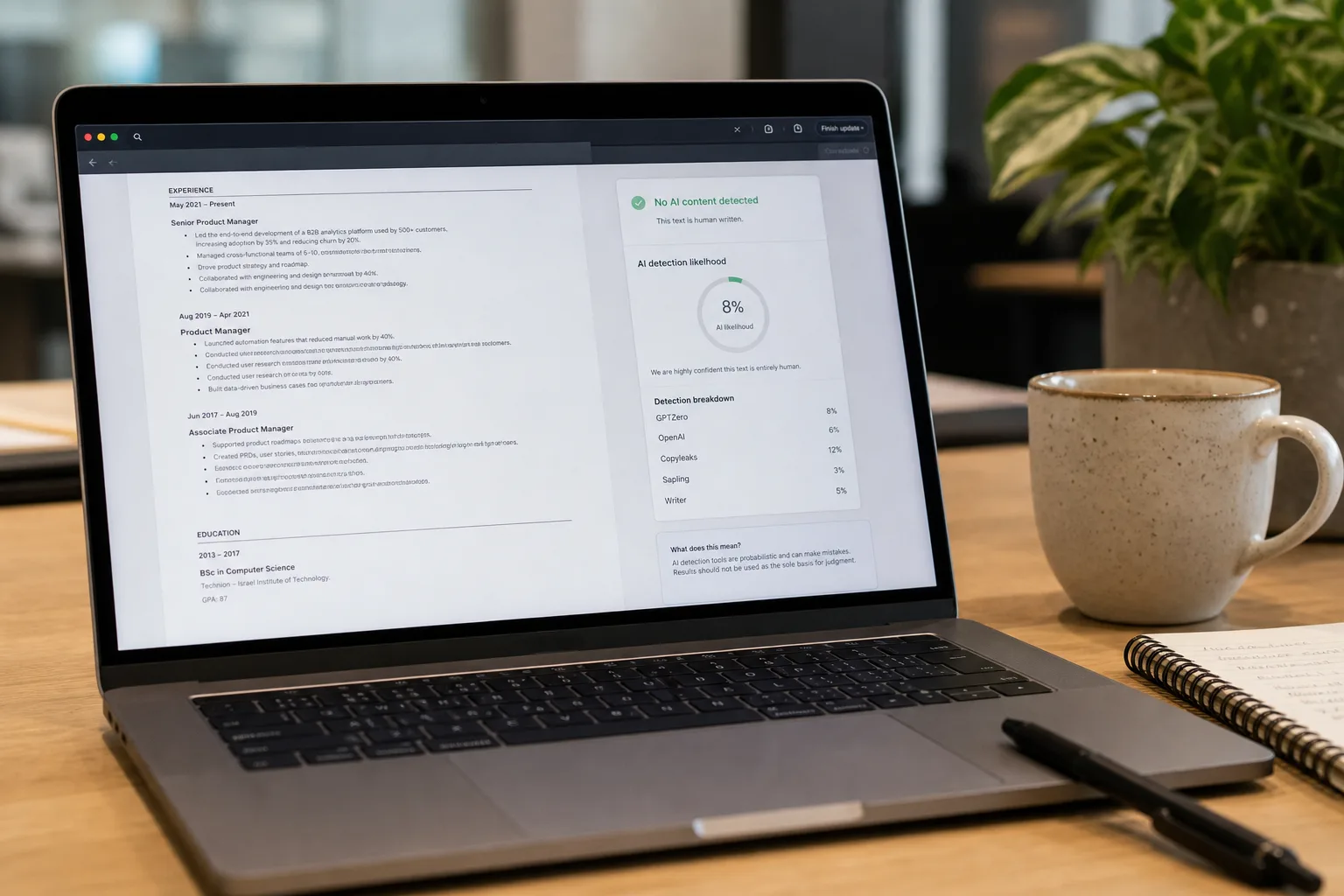
Short answer, up front: ATS platforms do not reliably "detect" that a CV was written with AI — there is no automatic red flag. But human recruiters detect something else: genericness. When half the candidates submit text that sounds identical, the problem isn't that you used AI — it's that you used it to sound like everyone else. And the real risk waits after screening: in the interview, when you're asked to stand behind a sentence a machine wrote for you.
Quick answer: what actually happens to an AI-written CV
Stage | What happens | Risk |
|---|---|---|
ATS screening | No reliable AI detection; the system checks keywords and field parsing | Low — if the CV is tailored to the role |
Recruiter (first 6–8 seconds) | Generic phrasing and identical buzzwords across dozens of candidates stand out | High — generic CVs get tossed even when "perfect" |
Deep review | Surveys of hiring managers: most lean toward rejecting unpersonalized AI CVs, and struggle to verify "AI-enhanced" skills | High — especially with inflated metrics |
Interview | Follow-up questions on every quantified achievement | Highest — "the resume passes the machine, the human fails the conversation" |
What the data says
Surveys of hiring managers published over the past year (mostly US market; the trend is identical in Israel) paint a consistent picture: ~62% of hiring managers say they're more likely to reject AI-written CVs that lack personalization — even after passing initial screening. ~65% say AI-enhanced CVs make it harder to verify whether the candidate actually has the listed skills. And ~78% explicitly look for personalized details as a signal the application is serious.
The other side of the same coin: ~67% of HR leaders report that the flood of AI-generated applications has slowed their hiring process. Recruiters themselves are drowning in generic text — and growing more sensitive to it. Some companies are reacting more radically: ~41% of employers are de-emphasizing the resume in favor of skills assessments and scenario evaluations.
The three places AI CVs blow up
1. The behavioral interview. "Tell me about the time you led the initiative written here." If the sentence came from a machine rather than real memory, the answer stumbles — and the interviewer spots the gap instantly.
2. Inflated metrics. "Improved performance by 40%" sounds great until someone asks how you measured it. A number you can't explain is worse than no number at all.
3. Skills inflation. The technology list AI "generously completed" gets tested in the technical screen within minutes. In the 2026 market there's nowhere to hide.
So how do you use AI right? Four rules
1. Start from your facts, not a blank page. AI sharpens the phrasing of real achievements — it doesn't invent a career. Every line on your CV must survive "tell me more about that."
2. Tailor every application to the specific role. This is exactly the difference between generic AI and a dedicated tool: a general chatbot produces pretty, uniform text; a tool that analyzes the job posting against your real CV produces fit. (The full guide to tailoring)
3. Keep your CV and LinkedIn consistent. Recruiters compare. Contradictions between the two are a bigger red flag than any AI suspicion.
4. Only write numbers you can defend. Before a metric stays on the CV, make sure you can explain exactly how it was calculated.
Bottom line: using AI on your CV is the norm now, not a shameful secret. What separates candidates in 2026 isn't "AI or no AI" — it's whether the result is tailored, accurate, and defensible in an interview.
FAQ
Can an ATS detect that a CV was written with ChatGPT?
Not reliably. Recruiting systems check structure, fields, and keyword match — not authorship. AI-text detectors exist but aren't dependable, and most recruiting systems don't run them on CVs.
Do recruiters reject AI-written CVs?
When they're generic — yes: most hiring managers in recent surveys report a growing tendency to reject unpersonalized AI CVs. A CV that used AI but is grounded in real experience and tailored to the role can't be detected — and there's no reason to reject it.
Should I disclose that I used AI to write my CV?
Not customary and not required — just as nobody discloses using a spell checker. What matters is that every fact on the CV is true and you stand behind it.
What's the difference between writing a CV with ChatGPT and a dedicated tool?
A general chatbot doesn't know the role, the company's recruiting system, or the Israeli market — so the output sounds like every other candidate's. A dedicated tool like Korotchaim starts from your real CV, analyzes the specific job posting, and computes a match score — so the AI works on personalization, not against it.
See how your CV looks against a real job posting — match score + what to fix, free, 30 seconds, no registration.