
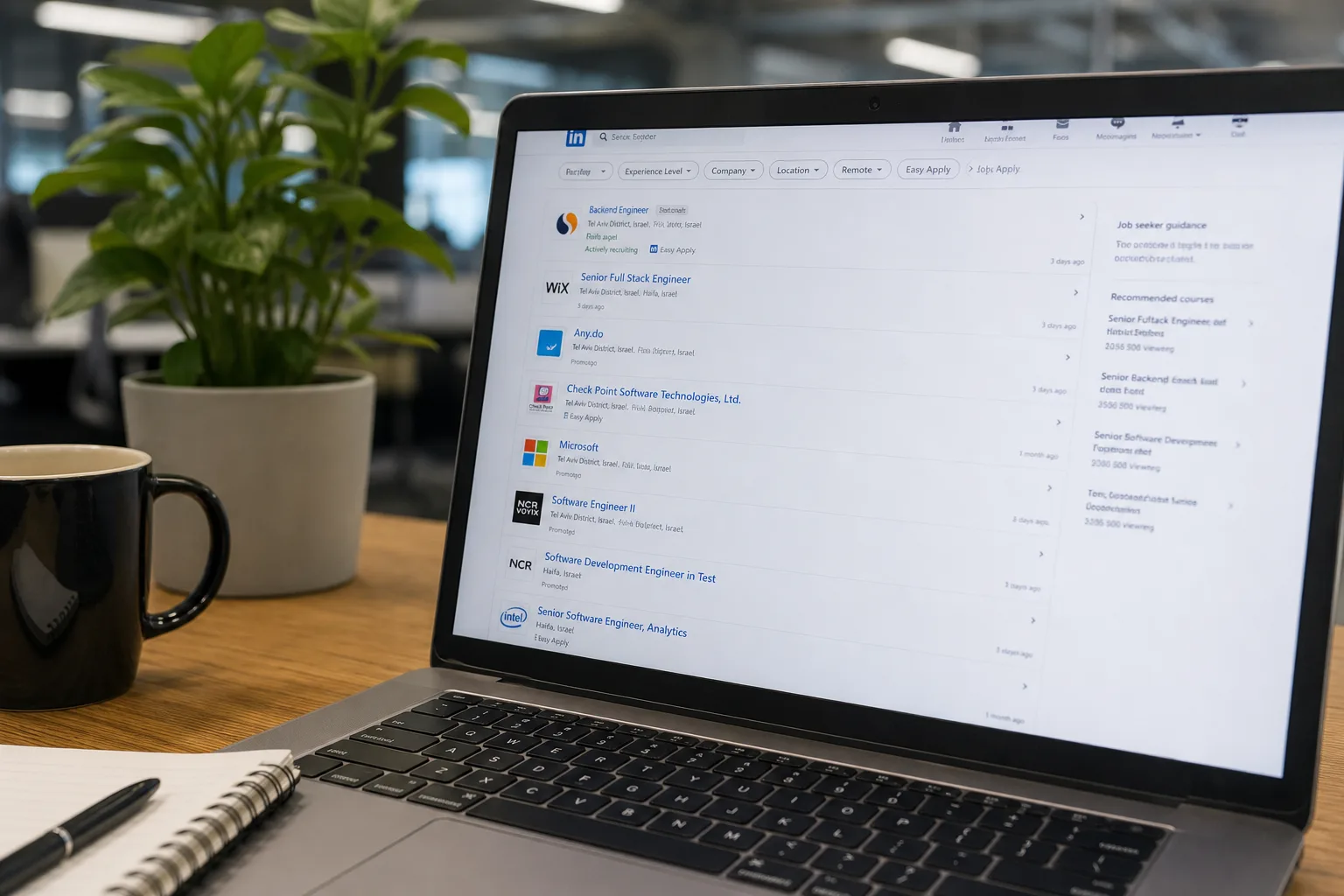
The official story you will hear about Israeli tech goes like this: it is the second largest tech hub outside Silicon Valley, English is the working language at every major company, the salaries are competitive, and your foreign experience is a bonus. All of that is true. None of it tells you what the job hunt is actually like.
The reality, after talking to two dozen olim and returning Israelis who landed jobs in tech in the last 18 months: it takes longer than you think, the rejection rate is higher than what you are used to, and the rules of the game are different from anywhere you have worked before. This article is the practical guide that nobody handed me when I started.
The 80% rule of Israeli tech
Eighty percent of every conversation about a tech job in Israel happens in English. Code, comments, technical docs, JIRA, Slack, even Zoom calls with cross-functional teams. The product is built in English, shipped in English, scaled in English.
The other twenty percent — the part that gets you hired — happens in Hebrew. Job postings on Israeli job boards, salary negotiation calls with HR, water-cooler conversations that turn into "we should add a person to my team", LinkedIn DMs from recruiters that start with "shalom". The hiring layer is Hebrew. The work layer is English.
If you do not speak Hebrew, this gap will cost you somewhere between 30 and 90 days of additional job-search time. Not because you cannot do the job — you can — but because every Hebrew conversation you cannot have is a deal you cannot make.
What works for English speakers
Apply through company sites, not Israeli job boards
The Israeli job boards (AllJobs, Drushim, JobMaster) are Hebrew-first. The English-fluent recruiters there triage. If your CV has no Hebrew at all, you will sit in their queue.
Skip them. Go directly to the careers pages of the companies you want — Wix, Monday, Lightricks, JFrog, Riskified, Pagaya, Forter, Honeybook. Those companies hire English speakers at scale and their ATS systems do not penalize for it.
Target companies with strong English DNA
Some companies in Israel are functionally English-first because most of their customers are in the US or because the founders insisted on it. Some examples in 2026: Monday, Wix, JFrog, Lightricks, Salt Security, Coralogix, Lemonade, Riskified, Pagaya, Snyk, Aqua Security. At these companies you can work for years and only learn Hebrew for the cafeteria.
Other companies — even big ones — are functionally Hebrew-first internally. Salesforce Israel, Microsoft Israel, Mellanox/NVIDIA, Check Point. The product is global but the day-to-day team conversations happen in Hebrew. Senior engineers tend to be fine without Hebrew at the global Israeli companies; juniors and mid-level struggle.
Have a 30-second "why Israel" story ready
Every Israeli interviewer will ask. They are not testing your loyalty; they are checking if you have thought through the move. Vague answers like "I love the energy" sound naive. Specific answers like "I have family here and I want to be closer / I am working on Aliyah for X reason / I have been visiting for 5 years and want to be here long-term" land better.
Have the story. Do not improvise it in the interview.
What does not work
Sending generic CVs to 50 jobs a week. The Israeli market is small and connected. The same recruiter sees your CV at 4 different companies in the same week. If it is generic, the impression is "spray and pray." If it is tailored — and you applied to three carefully — the impression is "this person is serious."
Salary negotiation by the US script. US tech salary negotiation involves leverage, competing offers, multi-week back-and-forth. Israeli negotiation is faster, less formal, and less adversarial. State your number, listen to the response, adjust once, accept or decline. Do not stretch it; you will look high-maintenance.
Ignoring the Israeli network you have. You probably know more Israelis than you think — at universities, at previous jobs in the US, through community. A warm intro at an Israeli company is worth more here than a cold application. Specifically: 5-10x more. Spend the first three weeks of your search mapping your network, not refining your CV.
The Hebrew question
Should you learn Hebrew before applying, or after you arrive?
If you are applying remotely from abroad, ulpan-level Hebrew (intermediate conversational) is not required for your first job. It is required for your second job — for the move from "the English speaker on the team" to "a person on the team who speaks English." That distinction is real and it determines your trajectory after year one.
The practical answer: start ulpan when you arrive. Most cities offer subsidized intensive Hebrew (5 days a week, 5 hours a day) for new olim. Your employer will usually let you take 6 months for it, sometimes paid. Do not skip this. It changes everything by year two.
The bilingual CV strategy
The CV most olim send is English-only. The CV that works best in 2026: English-primary with a one-line Hebrew header.
The header reads "אנגלית — שפת אם · עברית — בסיסית" or whatever your actual level is. This signals to the Hebrew recruiter who opens your CV that you are aware of the language layer, you are not pretending, and you are integrating. It costs you nothing and signals seriousness.
The Adapt Resume tool will automatically add this line when you set your CV target to an Israeli company.
The 6-month timeline
For an English speaker without Hebrew, the realistic timeline from "start serious search" to "first offer accepted" is 4-6 months. That is 2x what you would expect in the US or UK for an equivalent role.
Plan for it. Save accordingly. Use the time to do three things in parallel: send 5-7 highly-targeted applications a week (not 50), build your Israeli network (coffee chats, meetups, LinkedIn), and start Hebrew if you have not already.
How to use Korotchaim if you are an English speaker
Three tools, used in order:
- Match Analyzer — paste any Israeli tech job and your CV. See your fit score before you spend an hour on the application. Filter out the long tail.
- Adapt Resume — for the top 5-10 jobs you actually want, run your CV through this. It will rewrite using vocabulary that matches the job AND add the bilingual signal that helps with Israeli ATS systems.
- LinkedIn Optimizer — your LinkedIn matters more in Israel than anywhere else. Make sure it signals "open to work, in Israel, in tech, at this seniority" within 3 seconds of being opened.
All three are free for English speakers (and the entire site is bilingual — switch to /en for English UI).
The bottom line
Israeli tech is more accessible to English speakers than at any point in its history. You can absolutely land a strong role in 4-6 months without a word of Hebrew. The Hebrew unlocks a different ceiling later.
What helps most: pick fewer companies and apply better, prioritize warm intros over cold applications, run every CV through a job-specific adapter before sending, and start Hebrew the day you land. The combination of those four is what separates the people who get a job in 4 months from the people who get one in 12.